
The Karma Drone has been the first and only drone by GoPro so far. The Karma Drone had some interesting features like zoom selfies and safe return home.
But why has this drone been discontinued? Should I still buy it?
You’ll find the answer to these and other questions in this article, where you’ll also find a full review of the GoPro Karma drone and my personal opinion on it.
GoPro Karma Drone Review
The tale of Karma Drone hasn’t been quite happy! With several complaints about its battery life and its initial battery flaw that led to many of these drones falling down, this product has been through a lot of rough patches. So much so that it had to be discontinued back in 2018! We’ll discuss more about that later. Now let’s cover a a few important technical details and key features of GoPro Karma Drone.
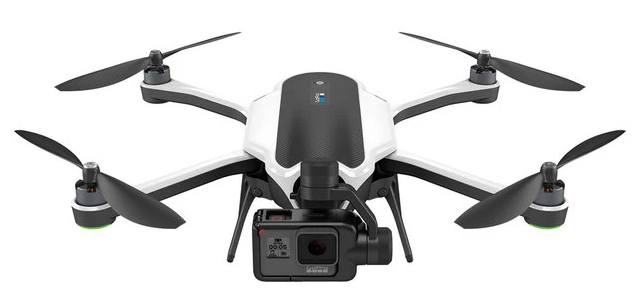
The image below shows exactly how a Karma drone looks like.
Technical Specs
- Maximum speed: 35 mph (56km/h)
- Range (Max Distance from Controller): 0.62 miles (1 km)
- Maximum flight altitude: 14,500 feet (4,500m)
- Operating frequency: 2.4 GHz.
- Maximum wind resistance: 22 mph (35km/h)
- Dimensions: 303mm x 411mm x 117mm (opened); 365.2mm x 224.3mm x 89.9 mm (folded)
- Propeller length: 10 inches (25.4 cm)
- Weight: 2.2 pounds (1kg)
Key Features
Camera: GoPro Karma drone can be used with the GoPro Hero 4, Hero 5 Black, or Hero 5 Session cameras. The design of this drone is unique in that the camera is placed on its nose rather than underneath its fuselage (as in case of most other quads). A stabilisation mount is also included to ensure shake-free footage with the gimbal.
Controller: The included controller weighs 625 grams and has a built-in 5-inch 720p touchscreen with a peak brightness of 700 nits. It offers one-touch operation for takeoff and landing. The battery life of the controller lasts for about 4 hours.
Operating modes: Karma drone has multiple automatic operating modes, which include:
- Dronie (for zoom selfies),
- Cable cam (for moving between one pre-defined point and another),
- Reveal (for panning until the subject is in the shot), and
- Orbit (for continuous circular pan around the subject).
Other Features: With GoPro drone, you can let your friends watch a live view of the drone’s footage. It also has the ability to be controlled from your smartphone. And, thanks to the amazing GoPro app, you can easily edit your shots as per your needs. The app lets you stitch together your footage, apply filters, music and more…
Have a look at the video below to know more about Karma Drone:
GoPro Karma Drone: Pros & Cons
Launched in 2016, Karma drone debuted as one of the most versatile and portable drones in the market. When it was announced in late 2015, there was a great excitement regarding this product amongst GoPro fans. It was one of the most sought-after drones in the market then. But it didn’t quite match up to its competitors in terms of various factors like flying range, battery life, stabilized indoor operation etc.
What we like: The first drone by GoPro, Karma is one of the most compact drones for photography. It is noticeably slimmer than many of its rivals and can easily fit into a small backpack (it comes with one as well). The drone is also lightweight; you can easily carry the entire kit all day without too much effort! What’s more? Karma is highly durable and versatile. Most of its components (like props, prop arms, landing gear, gimbal) are user-replaceable, in case of any damage.
GoPro Karma drone comes with Karma Grip gimbal included in the package. So, in addition to having a drone for your aerial imaging needs, you can detach the gimbal and transform it into a handheld stabilizer for smooth, shake-free footage. You just need to pop the gimbal off the drone via a simple unlocking mechanism and insert it into the Grip’s handle. That’s it! You have a stabilised handheld camera. The grip is also compatible with the amazing GoPro mounting system, which enables you to attach it securely to your car, bike, backpack and more…
Now, coming to the major aspect of what a drone is for exactly: performance in the air. With automated take-off & landing, and simple controls, it’s easy to fly. The GPS sensors ensure that it will return home when the battery is down or if the signal between controller and drone cuts out. When in sports mode, it can zip along at a brisk 35mph, while responding quickly to all your commands.
What we don’t like: Unfortunately, the Karma Drone is NOT very sturdy while it’s in the air. As a flyer, it feels a generation or two behind its major competitors like DJI and Yuneec. Without any ultrasonic sensors or external cameras, the drone doesn’t hover in place as steadily as other drones. There also aren’t any intelligent collision-detection or “follow me” features that have today become standard on quadcopters.
Another thing that we’re not quite impressed about is the battery. Lasting only 17 to 20 minutes tops, battery life is one of this quad’s most glaring weak points.
Why Was The Karma Drone Discontinued in 2018?
Karma Drone suffered a lot of setbacks in its journey. Just two weeks after it launched in 2016, the product suffered a full recall as there were several reports of drones spontaneously falling out of the sky after losing power during operation. However, the problem was later fixed after the company repaired the loose battery latch.
In 2017, Karma Drone reached the #2 market position in its price band, after DJI. But, there was still a lot of space between number one and two in the extremely competitive aerial market. Furthermore, a hostile regulatory environment in Europe and the United States reduced the total addressable market for drones. These factors, in addition to the company’s own financial woes led to GoPro’s abandonment of its drone aspirations.
So, in 2018 GoPro announced that the Karma Drone would be discontinued and that it will exit the drone market altogether after selling its remaining Karma inventory. The company, however, ensured that it will continue to provide service and support to its Karma drone customers.
GoPro Karma Drone Alternatives
There are many great alternatives to Karma Drone in the market. DJI, the current leading drone company, is one of the most popular drone makers for consumers in the world, with some amazing drones like DJI Mavic Pro and DJI Mavic Air.
DJI Drones are self-contained drones that include everything you need out of the box. They provide you with a great combination of high-end automation features and an outstanding performance. If you compare DJI drones with Karma, you’ll find that these drones by the Chinese maker are able to fly higher, for longer durations, and are capable of recording really high quality 4k footage.
DJI Mavic Pro
No products found.
DJI’s current drones now far outclass the 2018-era Mavic 2 Pro in camera quality, flight time, and range featuring a 20MP 1” CMOS Sensor for stunning color detail in your aerial shots. The drone has a flight time of up to 31 minutes, max speed of 44 mph, and takeoff weight of 907G. The 3-axis gimbal provides steady shots, and there’s 8GB internal storage with SD card support up to 128 GB.
The Mavic 2 Pro drone features ActiveTrack 2.0, Omnidirectional Obstacle Sensing, Hyperlapse, Low-Noise Design, Adjustable Aperture, and HDR Photos. The standard remote controller provides up to 135 minutes of battery life on a full charge, and the DJI GO 4 app can be used on your smartphone (iOS 10.0.2, Android 5.0 or above).
DJI Mavic Air
No products found.
The original DJI Mavic Air was a compact, powerful drone for its time, but it has long been discontinued and replaced by newer Air-series models. Equipped with a 3-axis gimbal and a 4K camera, it lets you shoot high-quality photos and videos from above.
With up to 21 minutes of flight time and a top speed of 42 mph, the Mavic Air can cover a lot of ground quickly. Its foldable design makes it easy to transport, and it weighs in at only 430g.
The Mavic Air comes with a variety of intelligent features, such as ActiveTrack, QuickShot, and SmartCapture, which make it easy to capture professional-quality shots with just a few taps on your smartphone. It also has obstacle avoidance sensors to help prevent crashes.
Should You Buy The GoPro Karma Drone Today?
As filmmaker, I’ve flown many different drones and the short answer to this question is: No. As you know, GoPro Karma Drones have been discontinued by the company, and are no longer available for purchase.
Combine this with the fact that there are actually much better drones available in the market presently, I would recommend you to buy GoPro Karma Drone only if you happen to find a really good second hand deal. Otherwise I’m quite sure that it’s no longer possible to buy a brand new GoPro Karma Drone.
For your information, I’m a DJI drone pilot and use only DJI for aerial photography and videography as it’s very reliable and has excellent image quality.
Thanks for reading!
I hope this guide helped you learn about GoPro Karma Drone 
Sharing is Caring 
If you found this article useful, please share it on social media with your family and friends!
Related Articles:
- 7 Best Drones for GoPro: Full Review & Specs Comparision
- GoPro Karma Battery: Specs, Flight time, Price
- 5 Most Expensive Drones You Can Buy (Professional High-End)
- Best Drones with a Camera UNDER $300 for Photo & Video
Frequently Asked Questions
Is the GoPro Karma drone still available to buy new in 2026?
No. GoPro discontinued the Karma back in 2018 and it has been off shelves for years. Your only realistic option now is a used unit from resale marketplaces, and even then you should expect no meaningful manufacturer support. I would only go this route if you find a genuinely good deal and mainly want it for the Karma Grip handheld stabilizer.
Can I use my current GoPro camera with the Karma drone?
No. The Karma mount and Grip were built specifically for the Hero 4, Hero 5 Black, and Hero 5 Session, and that mount does not fit newer cameras like the Hero 13 Black or the 2026 Mission 1 series. If you own a modern GoPro, Karma simply is not compatible hardware for it.
What app do I edit Karma footage with today?
GoPro’s mobile app, now branded GoPro Quik rather than just the GoPro app, still handles stitching clips, adding music and filters, and basic editing on your phone. Note that GoPro retired the separate Quik desktop app, so this kind of editing is mobile-only now.
What’s a good alternative to the Karma drone in 2026?
I fly DJI, and its current drones deliver far better range, flight time, and 4K image quality than Karma ever offered, well beyond the old Mavic Pro and Mavic Air models. One caveat for US-based readers: since late 2025 the FCC placed DJI on its Covered List, blocking new-unit imports, so you will mostly find existing dealer stock or used gear there; Autel and Anzu Robotics are solid non-DJI options if that matters to you.
Is the Karma Grip gimbal still worth using on its own?
Yes, honestly that is the best reason to still consider a used Karma kit. The detachable Grip works as a handheld stabilizer for any compatible Hero camera, and it still holds up for smooth walking shots. If you want similar stabilized-camera performance with current hardware instead, Insta360’s newer gimbal cameras like the Luna Ultra are worth a look, though those are self-contained cameras rather than an accessory for your existing GoPro.
Why was the Karma drone recalled and discontinued in the first place?
Two weeks after its 2016 launch, a loose battery latch caused several units to lose power and fall out of the sky, forcing a full recall. GoPro fixed the hardware issue, but by 2018, squeezed by DJI’s dominance and a tough regulatory climate in Europe and the US, the company decided to exit the drone market for good.

