
Quick Take
The DJI Pocket 4 uses the exact same sensor as the Pocket 3, so this isn’t an image-quality jump — it’s an experience upgrade, with faster slow motion, better tracking, and 107GB of storage built in.
If you want the full deep dive on the newer camera on its own, my DJI Pocket 4 review covers everything beyond this comparison.
The DJI Pocket 4 came out recently, and a lot of you are still deciding whether to upgrade or grab the Pocket 3 now that it’s dropping in price. On paper, DJI Pocket 4 vs Pocket 3 looks like a real step up: 4K at 240fps, full D-Log, 107GB of built-in storage, and smarter tracking. But there’s one thing the spec sheet won’t tell you — it’s the exact same sensor as the Pocket 3. So this isn’t the image jump you might be expecting. Here’s what actually changed, and which one’s the smarter buy for you.

Is the Image Any Better?
Start with what actually changed going from the Pocket 3 to the Pocket 4: the camera keeps the same shape and size, the same 1-inch sensor, and the same 20mm f/2.0 lens, so in good light the footage from both looks really close.
What the Pocket 4 Upgrades
Where the Pocket 4 pulls ahead is everything wrapped around that sensor. You get 4K at 240fps, twice as smooth as the Pocket 3’s slow motion, dynamic range up to 14 stops, and full D-Log instead of the cut-down D-Log M you were stuck with before. That one’s personal for me — I’ve spent too many late nights fighting D-Log M in the grade, trying to pull back a blown-out sky that just wasn’t there anymore. Full D-Log gives real room to push color before it falls apart. The ISO ceiling roughly doubled too, the screen got brighter, and photos jump from about 9 megapixels to 37.
Storage and Audio
Storage is the upgrade I’d actually pay for. The Pocket 4 has 107GB built in on top of the microSD slot; the Pocket 3 had none, so forgetting a card meant losing the whole day. I once had a card corrupt on me and lost a whole morning of clips — after that happens once, storage you can’t lose stops being a luxury. Audio steps up to four-channel recording from two, which matters when I’m vlogging on a busy street or grabbing a quick interview and need more to balance in the edit.
Tracking
The Pocket 3 ran ActiveTrack 6, which was fine, but I’ve had it drop me at the worst moment — step out of frame for a second and it locks onto a stranger walking past. The Pocket 4 moves up to ActiveTrack 7: it grabs on faster, holds better when someone crosses in front of you, and lets go a lot less often.
Vertical Video, Price, and the US Problem
Both cameras rotate the head for true vertical video and flip the screen to face you, plus both shoot photos, time-lapse, and motion time-lapse. On price, the Pocket 4 lands around $499 standard or $740 for the Creator Combo, while the Pocket 3 — two years into its run — typically sells for $400 to $500 and has dipped near $400 on sale. If your budget is tight and you mostly shoot in good light, that gap is hard to ignore.
If you’re in the US, this next part might decide it for you: DJI has been on the FCC’s Covered List since late last year, and the Pocket 4 never got clearance, so you can’t buy it from DJI directly — though it has shown up on Amazon. The Pocket 3 made it in before those regulations took effect, so it’s still sold through the DJI store, Amazon, and everywhere else.
Accessories, Battery, and Waterproofing
Most Pocket 3 accessories work fine with the Pocket 4, since the body size and shape are nearly identical. Neither battery is swappable — on a full charge, DJI rates the Pocket 4 at up to 240 minutes versus the Pocket 3’s 166 minutes, though both numbers drop once you shoot 4K. Neither camera is waterproof, so for water or rain, grab a case or reach for an action camera built for it, like the DJI Action 6.
Which One Should You Buy?
If you already own a Pocket 3 and it’s doing the job, don’t rush to upgrade — the image is close, and most of what you’re paying for is features mainly used in professional shoots, like D-Log for grading or the extra dynamic range. If you do client work or need more control, the Pocket 4 makes sense. And if what you’re really weighing is the Pocket 3 against DJI’s dual-lens Pocket 4 Pro, my Pocket 4 Pro vs Pocket 4 vs Pocket 3 breakdown covers that comparison in full.
Do the DJI Pocket 4 and Pocket 3 use the same sensor?
Yes. Both use the same 1-inch sensor and 20mm f/2.0 lens, so image quality in good light is very similar. The Pocket 4’s upgrades are mostly in frame rate, dynamic range, storage, and tracking rather than raw image quality.
Is the DJI Pocket 4 worth it if I already own a Pocket 3?
For most casual users, not urgently. The core image quality is nearly identical, so unless you need full D-Log for grading, faster slow motion, or built-in storage, the Pocket 3 still covers most everyday use.
Can you buy the DJI Pocket 4 in the US?
Not directly from DJI. The Pocket 4 hasn’t received FCC clearance for official US sale, but it is available through Amazon and other third-party retailers. The Pocket 3 was cleared before the restrictions took effect and is still sold through official channels.
How much internal storage does the DJI Pocket 4 have?
The Pocket 4 has approximately 107GB of built-in storage in addition to its microSD card slot. The Pocket 3 has no internal storage at all.
DJI Pocket 4 vs Pocket 3: Gear Mentioned
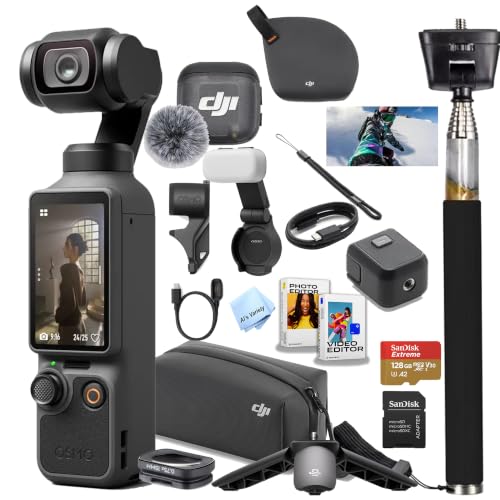
- DJI Osmo Pocket 4-1″ CMOS & 4K/240fps, 14-Stop Dynamic Range, 10-bit D-Log, 3-Axis...
- DJI Mic 3 Clip-On Transmitter/Recorder with Built-In Microphone- For Mic 3 Wireless...
- DJI Wide-Angle Lens for Osmo Pocket 4- Capture a wider image in every frame with this...

- Capture Stunning Footage - Osmo Pocket 3 vlogging camera features a 1-inch CMOS...
- Effortlessly Frame Your Shots - Get the ideal composition with Osmo Pocket 3's...
- Ultra-Steady Footage - Say goodbye to shaky videos! Osmo Pocket 3's advanced 3-axis...

