
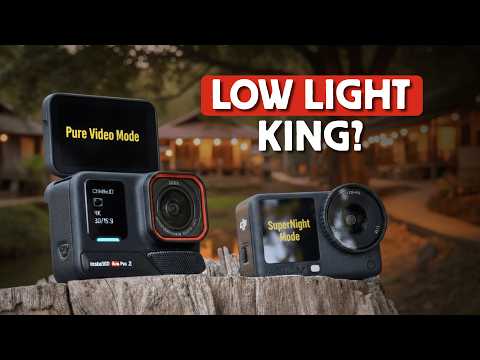
Most action cameras look acceptable in low light when you’re standing still. The real test is what happens when you start moving — walking through mixed lighting, turning, changing direction — and that’s where the gap between the DJI Action 6 e Insta360 Ace Pro 2 becomes visible. This comparison focuses specifically on that scenario: real movement, real low-light conditions, side by side. Here’s what you actually see.
DJI Action 6 low light: detail over polish
The DJI Action 6 consistently prioritizes retaining texture and real detail over giving you a smooth, processed look. In low-light walking shots, that means you’ll see more grain — but also more genuine information in the image. Textures on surfaces, fine details in faces, the structure of objects in the background. That grain isn’t always a problem; it’s often the byproduct of keeping more actual data in the frame.
The feature that separates the Action 6 here is its abertura variável — opening up to f/2.0 to let in more light instead of pushing ISO as hard. In practice, this shows up when you move between brighter and darker areas: passing under streetlights, walking away from shop windows, crossing through mixed lighting. The Action 6 tends to stay more consistent in exposure and color because it’s physically gathering more light rather than compensating in software. It’s a small spec on paper, but it makes a real difference in the scenarios where action cameras typically struggle.
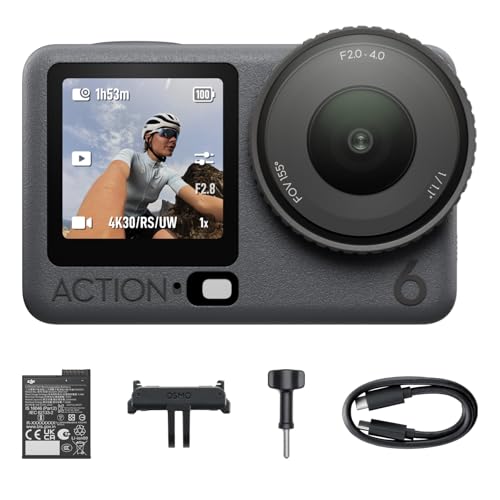
- Capture Every Scene, Day or Night - Variable aperture f/2.0 [1]-f/4.0 adapts for...
- Detailed Action in Every Frame - The all-new 1/1.1″ square sensor boosts this...
- 360° HorizonSteady [11], Rock-Solid Footage - Advanced stabilization minimizes 360°...
Insta360 Ace Pro 2 low light: smooth and ready to post
The Insta360 Ace Pro 2 takes the opposite approach — processing the image aggressively to produce footage that looks polished and clean straight out of camera. In many low-light scenes, this looks genuinely better at a glance: brighter shadows, cleaner overall image, less visible grain. The flip screen makes framing fast, and the Pure Video low-light mode brightens the scene noticeably.
Where the Ace Pro 2’s processing approach shows its limits is in texture detail and in very dark areas. When the camera is doing a lot of work to clean up noise, fine details can smooth out — faces, patterns, and small objects in the background tend to lose definition. On a phone screen, this often looks fine. On a larger display, the difference between real detail and smoothed processing becomes more apparent. The full Insta360 Ace Pro 2 review has more on how this plays out across different shooting scenarios.
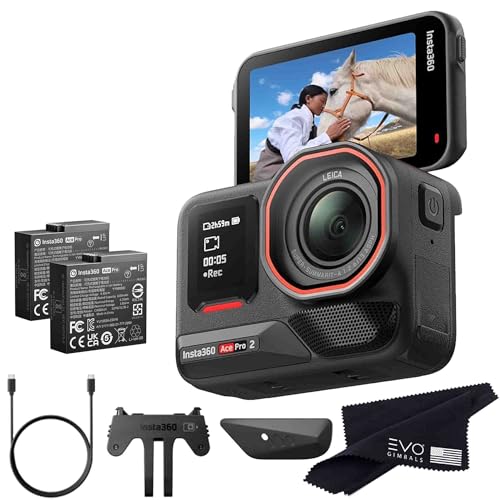
- Flagship 1/1.3" 50MP Sensor and 5nm AI Chip: Armed with a larger, premium sensor, Ace...
- Wide-Angle Leica f/2.6 Lens: Leica brings its legendary expertise in optical design...
- Unbeatable Image Quality by Day and Night: Record 4K60fps slow-mo and utilize Active...
Night mode compared: Super Night vs Pure Video
Both cameras have dedicated low-light modes — Super Night on the DJI, Pure Video on the Ace Pro 2. These modes increase processing significantly: the camera makes more decisions about what stays sharp and what gets smoothed. In static shots, both look good. Moving, the DJI tends to stay more structurally consistent while the Ace Pro 2 can show more processing artifacts in very dark areas — small lights changing shape, textures losing definition. Push either camera hard enough and you’ll see the limits, but the DJI’s physical aperture gives it a slight edge in the darkest real-world scenarios.
Which one to choose
If you color grade your footage or need to match clips across multiple cameras — drones, other action cams, a larger camera — the Action 6 gives you more flexibility because it keeps more real information in the image. You can push it in post without hitting processing artifacts as quickly. If you use DJI gear across your kit, the consistent color science is also a practical advantage.
If you want footage that looks finished straight out of camera — quick travel clips, social content, anything where you want to spend less time in editing — the Ace Pro 2 is the faster path. The processing does the work for you, and for most viewing contexts, the result looks excellent. Neither is a wrong choice; they’re built for different workflows. For SD card compatibility with the Action 6, check the recommended DJI Osmo Action SD cards.
Neither is objectively better — they are optimized differently. The DJI Action 6 retains more real texture and detail using its variable aperture (f/2.0), making it better for color grading and footage matching. The Insta360 Ace Pro 2 produces smoother, more polished footage that looks ready to post without editing, making it better for casual shooting.
Variable aperture means the DJI Action 6 can physically open its lens wider — up to f/2.0 — to let in more light in dark environments. This reduces the need to push ISO as high, which helps preserve image quality and keeps exposure more consistent when moving between different lighting conditions.
Pure Video is the Insta360 Ace Pro 2’s dedicated low-light mode. It increases computational processing to brighten the image and reduce noise, resulting in cleaner, brighter footage in dark environments. The tradeoff is that fine texture detail can be smoothed out, especially in very dark scenes with movement.
The DJI Action 6 can run warm in extended high-resolution shooting, but low-light shooting in standard mode generally doesn’t push the camera harder than daylight use. The variable aperture actually reduces thermal load slightly by needing less processing compared to a fixed-aperture camera pushing high ISO.
For travel vlogging where you want quick, shareable footage with minimal editing, the Insta360 Ace Pro 2 tends to produce more pleasing results out of camera. For creators who color grade or need footage to match with other cameras, the DJI Action 6 provides more flexibility and more consistent behavior across different lighting situations.


 English
  Italiano
  Deutsch
  Español
  Português
  Nederlands
  Français