
Quick Take
De DJI Osmo Action 6 en Insta360 Ace Pro 2 are the two best action cameras of 2026 — but they solve different problems. The Action 6 gives you 10-bits kleur, a variable aperture (f/2–f/4), and clean integration with other DJI gear — ideal if you’re building a controlled, color-graded edit. The Ace Pro 2 gives you a flip-screen, faster workflow, and footage that looks finished straight out of camera — ideal if you want to capture and post without friction. Neither is objectively better. The right one depends entirely on how you shoot.
Nobody talks about it, but the DJI Action 6 vs Insta360 Ace Pro 2 is one of the hardest buying decisions in the action cam space right now — same sensor, same price, genuinely excellent footage from both. After testing both, the right call comes down to one question — here’s the answer.
DJI Action 6 vs Insta360 Ace Pro 2: at a glance
| Functie | DJI Osmo Action 6 | Insta360 Ace Pro 2 |
|---|---|---|
| Sensor | 1/1.3 inch | 1/1.3 inch |
| Max video | 4K 120fps | 8K 30fps |
| Color depth | 10-bit | 8-bit |
| Log profile | D-Log M | LOG+ |
| Diafragma | Variable f/2–f/4 | Fixed f/2.8 |
| Flip screen | No (front touchscreen) | Ja |
| Best voor | Color work, ecosystem | Speed, social content |
| Price (approx.) | ~$349 | ~$349 |
Same sensor size, same price bracket, excellent stabilization on both. That’s why looking at the spec sheet won’t help you decide — you need to look at how you shoot.
The DJI Action 6: for shooters who think before they hit record
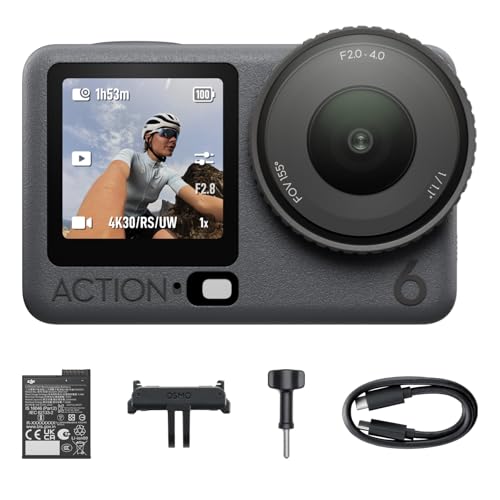
- Capture Every Scene, Day or Night - Variable aperture f/2.0 [1]-f/4.0 adapts for...
- Detailed Action in Every Frame - The all-new 1/1.1″ square sensor boosts this...
- 360° HorizonSteady [11], Rock-Solid Footage - Advanced stabilization minimizes 360°...
Pick up the Action 6 and something shifts. It feels like a tool — designed to fit inside a workflow, not just stand on its own. The 10-bit D-Log M recording gives you real room to grade in post, and the mechanical variable aperture (f/2 to f/4) is genuinely unusual on an action camera. At f/2 you’re pulling in more light with a slightly shallower look; at f/4 you get consistent depth for wide action shots. It’s the kind of feature that makes sense if you’re already thinking about the edit before you hit record.
The bigger advantage shows up if you’re running a multi-camera setup. If you’re also shooting with a DJI Pocket 3 or a DJI drone, the Action 6 color-matches across all of them cleanly — that’s a real time-saver in post. It’s the reason a lot of creators who are already deep in the DJI ecosystem don’t seriously consider anything else. For SD card recommendations that can keep up with 4K 120fps, see our guide to recommended SD cards for DJI Osmo Action cameras.
The tradeoff is that it rewards intentional shooting. If you’re not thinking about profiles and exposure before you start recording, you’re leaving most of what it offers on the table.
The Insta360 Ace Pro 2: for shooters who want to capture more, faster
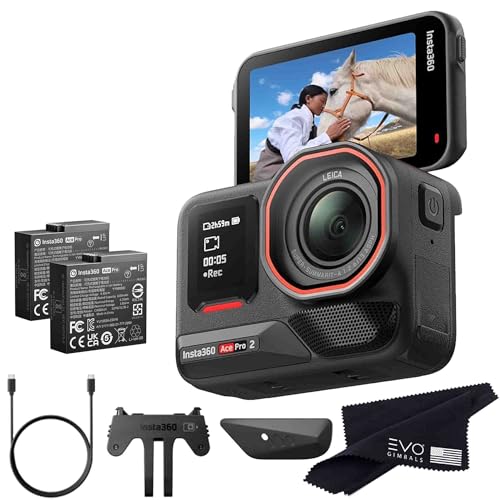
- Flagship 1/1.3" 50MP Sensor and 5nm AI Chip: Armed with a larger, premium sensor, Ace...
- Wide-Angle Leica f/2.6 Lens: Leica brings its legendary expertise in optical design...
- Unbeatable Image Quality by Day and Night: Record 4K60fps slow-mo and utilize Active...
The Ace Pro 2 takes the opposite approach. Its design philosophy is about removing friction — between having an idea and getting the shot. The flip-screen makes selfie framing instant, no guessing or adjusting after the fact. The standard color profiles are tuned to look good straight out of camera, which means footage that’s ready to post without grading.
The practical result: you shoot more. When a camera feels easy to use, you reach for it more often — and more footage usually means more keepers, regardless of what the spec sheet says. The 8K ceiling also gives it a resolution edge if you need to crop or reframe in post, and its low-light performance is genuinely excellent. Read the full Insta360 Ace Pro 2 review for a deeper look at real-world performance, and see how it matches up against another top competitor in the GoPro Hero 13 vs Insta360 Ace Pro 2 comparison. For the right SD card to handle 8K recordingkijk dan bij the best SD cards for Insta360 Ace Pro.
The limitation is the 8-bit recording ceiling. For color-heavy grades or footage that needs to match other cameras, 8-bit leaves noticeably less room to work with.
Which one is actually right for you
The clearest question to ask yourself: how much time do you want to spend in post?
If the answer is “as little as possible” — you’re shooting travel content, reels, day-in-the-life footage, anything you want to post quickly — the Ace Pro 2 is the better fit. Lower barrier to entry, faster output, footage that’s ready to use.
If the answer is “I want control over the final look” — you’re cutting a professional project, matching to drone footage, or building a color-graded edit — the Action 6 earns its place. The 10-bit pipeline and DJI ecosystem integration make the extra workflow overhead worth it.
If you’re genuinely on the fence, the deciding factor is usually the flip-screen. It’s either something you’d use constantly or something you’d never miss — and your honest answer to that probably tells you everything you need to know.
Neither is objectively better — they’re optimized for different things. The Action 6 is better for color-graded, professional workflows and DJI ecosystem integration. The Ace Pro 2 is better for fast, frictionless content creation. Both are top-tier action cameras in 2026.
No. The Action 6 maxes out at 4K 120fps. The Insta360 Ace Pro 2 can shoot 8K at 30fps, which gives it a resolution advantage for cropping and reframing in post.
No. The Ace Pro 2 is limited to 8-bit recording. The DJI Action 6 shoots 10-bit, giving it significantly more headroom for color grading.
Both work well for YouTube. If your content is vlog-style, talking-head, or travel footage, the Ace Pro 2’s flip screen and post-ready footage give it a practical edge. If you’re producing more cinematic content or matching to drone footage, the Action 6 is the better call.
The DJI Action 6 received FCC authorization before the December 2025 ban took effect, so it remains available in US retail while stock lasts. New DJI products announced after the ban cannot enter normal US retail channels.


 English
  Italiano
  Deutsch
  Español
  Português
  Nederlands
  Français