
Quick Take
Tutta la DJI Pocket 3 (~$400) is still a brilliant buy and the value pick. The DJI Pocket 4 (~$499) is a real day-to-day upgrade — full D-Log, longer battery, 107GB built in — but the same sensor. The Pocket 4 Pro (expected late June, ~$900) is the big one: a dual lens with true 3x optical zoom. If the fixed wide angle has ever frustrated you, that’s the one to wait for.
I’ve shot with the DJI Pocket 3 for a long time — trips, professional jobs — and it’s never let me down. But the Pocket 4 is already out, and the Pocket 4 Pro with its dual zoom lens is dropping very soon. So in this DJI Pocket 4 Pro vs Pocket 4 vs Pocket 3 breakdown, the real question is simple: do you grab something now, or wait for the Pro? Here’s how I’d decide.
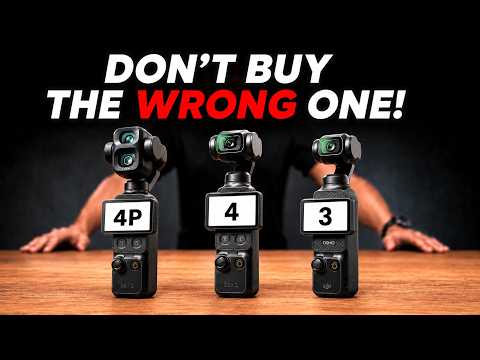
DJI Pocket 4 Pro vs Pocket 4 vs Pocket 3: at a glance
| Caratteristica | Pocket 3 | Pocket 4 | Pocket 4 Pro (expected) |
|---|---|---|---|
| Lenti | Single | Single | Dual (wide + tele) |
| Sensore | 1-inch | 1-inch (same) | 1-inch + telephoto |
| Optical zoom | No | No | 3x (≈24–70mm) |
| Log profile | D-Log M | Full D-Log | Full D-Log (improved DR expected) |
| Rallentatore | 4K 120fps | 4K 240fps | 4K 240fps (expected) |
| Tracking | ActiveTrack 6 | ActiveTrack 7 | ActiveTrack 7 (expected) |
| Built-in storage | Nessuno | 107GB | 107GB (expected) |
| Waterproof | No | No | No |
| Prezzo | ~$400 | ~$499 | ~$900 (leaked) |
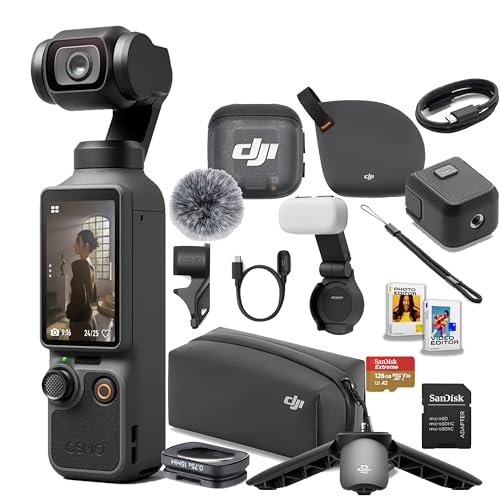
- DJI Osmo Pocket 4-1″ CMOS & 4K/240fps, 14-Stop Dynamic Range, 10-bit D-Log, 3-Axis...
- DJI Mic 3 Clip-On Transmitter/Recorder with Built-In Microphone- For Mic 3 Wireless...
- DJI Wide-Angle Lens for Osmo Pocket 4- Capture a wider image in every frame with this...

- Capture Stunning Footage - This vlogging camera features a 1-inch CMOS sensor and...
- Effortlessly Frame Your Shots - Get the ideal composition with Osmo Pocket 3's...
- Ultra-Steady Footage - Say goodbye to shaky videos. Osmo Pocket 3's advanced 3-axis...
What’s new on the Pocket 4 — and the Pro
Going from the Pocket 3 to the standard Pocket 4, the changes are mostly about experience, not image quality — the sensor is basically the same 1-inch unit. But the dynamic range improved to 14 stops, and it jumped from D-Log M to full D-Log. D-Log M had a ceiling on how far you could push it in post — I’ve spent real time fighting it in color grading — and full D-Log is what DJI uses on its higher-end cameras and drones, so you get more room to grade before the image falls apart. Add 4K/240 slow motion, around 200 minutes of battery, and 107GB of internal storage next to the microSD slot, and it’s a noticeably better camera to live with, even though the picture itself is close to the Pocket 3.
Tutta la Pocket 4 Pro is a different story. It hasn’t shipped yet, but the headline is a dual-camera system — a wide lens plus a dedicated telephoto — and that’s where the 3x optical zoom comes from, pushing to 12x with digital help. The 3x is clean optical with no quality loss; past that you’ll start to see softening, so the sweet spot is that 3x. For the first time on a Pocket camera, you’re not locked to a wide shot — roughly 24mm out to 70mm. The camera head is physically larger to fit the dual lens, so it’ll feel a bit different handheld over a long session.
Subject tracking
Tracking doesn’t get enough attention in these comparisons, and it’s one of the most useful features if you film yourself. The Pocket 3’s ActiveTrack 6 was already solid; the Pocket 4’s ActiveTrack 7 locks on faster and holds better when something briefly crosses in front of you. If you’ve ever had the Pocket 3 drop tracking at the worst moment, this is the version that fixes it. The Pro is expected to carry the same system, and its dual camera could make it smarter still, with more visual information to work from.
Are the DJI Pocket 4 and 4 Pro waterproof?
The short answer is no — none of the Pocket cameras are waterproof. A Pocket is a precision gimbal with exposed moving parts, which makes sealing it genuinely hard to engineer, though DJI did add an SD card door to keep dust out. If weather resistance matters, use a protective case, or reach for an action camera like the DJI Action 6 in those conditions. That’s exactly what I do when I’m not sure about the weather.
US availability
If you’re in the US, this matters. DJI has been on the FCC’s restricted list since last December, so you won’t find the Pocket 4 in DJI’s own US store or directly on Amazon — only through some third-party retailers, usually at a markup. The Pocket 4 Pro hasn’t launched yet; DJI is targeting the end of June, China first, then the rest of the world. For the US specifically, reporting suggests it’ll arrive under a rebranded name, the Xtra Muse 2 Pro — a near-identical camera sold by a separate company, with all signs pointing to DJI hardware underneath. It’s the same workaround the previous Pocket used to reach US shelves. Outside the US, none of this applies and the Pocket 4 is widely available.
Prezzo
Here’s where it gets interesting. The Pocket 3 has dropped to around $400. The Pocket 4 runs about $499 for the base kit, roughly $700 for the creator combo (US third-party prices often run higher). Based on the leaks, the Pocket 4 Pro is expected near $900, with a full combo potentially over $1,000 once you add new lens accessories. At that price the Pro starts competing with mirrorless cameras and high-end phones, so DJI really needs to deliver on the specs to justify it.
Pocket 3 vs 4 vs 4 Pro: should you upgrade?
If you’re already on a Pocket 3 and it’s working for you, I wouldn’t rush. It’s on sale, the image quality is very close to the standard Pocket 4 for casual use, and with the Pro just weeks away it makes more sense to wait and see how it performs. The Pocket 4 is better in practical ways — battery, full D-Log, slow motion — but unless you shoot professionally, I wouldn’t jump to the priciest option just yet.
If you non have a Pocket camera yet, the Pocket 3 at today’s price is a strong buy — two years old, mature firmware, a solid accessory ecosystem, and never cheaper. And if you’ve been waiting for a real reason to upgrade — especially if that fixed wide angle has frustrated you — the Pocket 4 Pro is probably worth the wait. It’s the first time the Pocket line has actually addressed that limitation. Trying to choose against Insta360’s newcomer instead? I put them head-to-head in the Luna Ultra vs DJI Pocket 4 comparison.
Frequently asked questions
For most people, not urgently. The Pocket 4 uses the same 1-inch sensor as the Pocket 3, so image quality is close. The real gains are full D-Log, 14 stops of dynamic range, 4K/240 slow motion, longer battery, and 107GB of built-in storage. If you grade footage or shoot professionally, those matter; for casual use, the Pocket 3 still holds up.
DJI is targeting late June 2026, launching in China first and then globally. Leaks point to around $900, with a full combo potentially over $1,000. Pricing and exact dates aren’t official yet, so treat them as estimates.
The biggest difference is the lens. The Pocket 4 is single-lens and fixed-wide; the Pocket 4 Pro adds a dedicated telephoto for 3x true optical zoom (about 24–70mm) and a larger camera head to fit it. The Pro is also expected to improve dynamic range further.
No. None of the DJI Pocket cameras are waterproof, because the gimbal has exposed moving parts that are hard to seal. Use a protective case in wet conditions, or a dedicated action camera like the DJI Action 6.
Not through DJI’s US store or directly on Amazon — DJI has been on the FCC restricted list since December 2025. Some third-party US retailers carry it, usually at a markup. The Pocket 4 Pro is expected to reach the US under a rebranded name, the Xtra Muse 2 Pro.


 English
  Italiano
  Deutsch
  Español
  Português
  Nederlands
  Français