
Quick Take
Le DJI Osmo Action 6 brings two things nobody expected on an action camera: a variable f/2–f/4 aperture et 10-bit D-Log M recording. If you shoot in changing light or want real grading latitude, it earns its place. If you want fast, frictionless footage straight out of camera, the Insta360 Ace Pro 2 is the simpler pick.
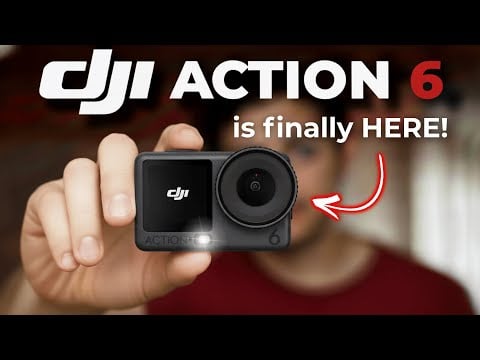
Le DJI Osmo Action 6 review starts with one feature nobody saw coming on an action camera: a mechanical variable aperture. It sounds like a spec sheet detail — it shoots like a different category of camera.
The aperture and 10-bit: what actually changed
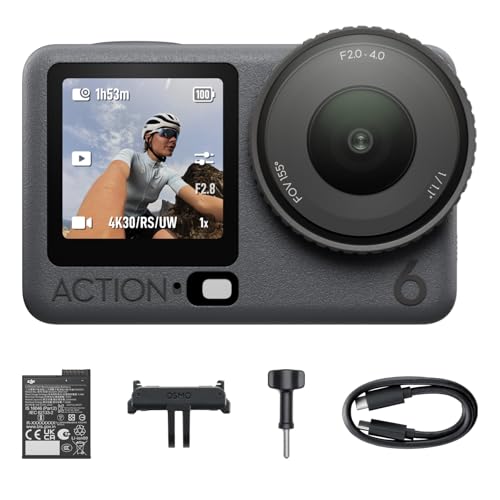
- Capture Every Scene, Day or Night - Variable aperture f/2.0 [1]-f/4.0 adapts for...
- Detailed Action in Every Frame - The all-new 1/1.1″ square sensor boosts this...
- 360° HorizonSteady [11], Rock-Solid Footage - Advanced stabilization minimizes 360°...
Le variable aperture (f/2 to f/4) is a first for action cameras. At f/2 you pull in more light with a slightly shallower depth of field — useful in low light or for a more cinematic look. At f/4 you get consistent, deep focus for wide fast-action shots. Combined with 10-bit D-Log M recording, this is a camera built for creators who think about the edit before they hit record. The 10-bit codec preserves real grading headroom in highlights and shadows that 8-bit footage simply cannot recover.
Specs: sensor, stabilization, storage
The Action 6 shoots on a 1/1.3 inch sensor and maxes out at 4K 120fps. Stabilization is handled by Rock Steady 4.0 — DJI’s latest system — which keeps footage clean even at high resolutions. The body is matte black with a metallic internal frame that acts as a heat sink, a genuine improvement over the Action 5 Pro where overheating was a real issue during long sessions. It also ships with 64GB of built-in storage plus a microSD slot. For the 4K 120fps modes you want a fast card — see our guide to the recommended SD cards for DJI Osmo Action cameras.
Who it is actually for
The Action 6 rewards intentional shooters. If you are running a multi-camera setup — pairing it with a DJI Osmo Pocket 3 or a DJI drone — the color matching across the ecosystem is seamless and saves real time in post. For travel creators or anyone who wants post-ready footage fast, the Insta360 Ace Pro 2’s flip screen and simpler workflow may suit better. One practical note: the Action 6 received FCC authorization before the December 2025 DJI ban, so it is still available in US retail while stock lasts.
Frequently asked questions
Yes. The Action 6 records in 10-bit with D-Log M color profile, giving significant latitude for color grading in post. This is one of its main advantages over the Insta360 Ace Pro 2, which is limited to 8-bit.
The Action 6 has a mechanical variable aperture between f/2 and f/4 — the first action camera to offer this. At f/2 you get more light and a slightly shallower look; at f/4 you get deep, consistent focus for wide action shots.
The Action 6 adds 10-bit recording, a variable aperture, and Rock Steady 4.0 stabilization — all meaningful upgrades. The sensor size is similar but the added creative control makes it a significant step up for serious creators.
Yes. The DJI Osmo Action 6 is waterproof to 20 meters natively, with no housing required.
For 4K 120fps you need a UHS-I V30 or faster card. The Action 6 also has 64GB of internal storage built in. See our guide to the best SD cards for DJI Osmo Action cameras for specific picks.


 English
  Italiano
  Deutsch
  Español
  Português
  Nederlands
  Français