
Quick Take
The Insta360 Luna Ultra ($769.99) is the more capable camera — dual lenses, real optical zoom, and a detachable remote screen. The DJI Pocket 4 ($499) is simpler, cheaper, and more refined, but it’s a single lens with the same sensor as the Pocket 3. Buy on how you shoot — and, if you’re in the US, on which one you can actually get.
If you’re shopping for a pocket camera, it’s probably down to the Insta360 Luna Ultra vs DJI Pocket 4. The Luna is the flashy newcomer — two lenses, a true zoom, a screen that pops off as a remote. The Pocket 4 is the simpler, cheaper single-lens option. So the Luna looks like the obvious pick. But the Luna is Insta360’s first pocket camera ever, and DJI is already on its fourth — and that gap cuts both ways. Here’s which one is actually worth your money.
What each camera actually is
These two are more different than they look. The Luna Ultra is Insta360 jumping into pocket cameras for the first time, and they came in swinging: two lenses up front — a 1-inch main and a separate telephoto — for a true optical zoom of about 3x, Leica-tuned color, 8K recording, and that screen that detaches into a wireless remote.
The Pocket 4 takes the opposite approach, and that simplicity is the point. One lens — and the detail people skip over is that it uses the same 1-inch sensor as the Pocket 3. So the picture quality itself isn’t really the upgrade. The money goes into everything around it: sharper tracking, built-in storage, smoother slow motion — the things DJI has polished over four generations.
Insta360 Luna Ultra vs DJI Pocket 4: specs
| Feature | Insta360 Luna Ultra | DJI Pocket 4 |
|---|---|---|
| Lenses | Dual (main + telephoto) | Single |
| Optical zoom | Yes (~3x) | No |
| Max video | 8K 30fps | 4K 120fps · 240fps slow-mo |
| Color | 10-bit, I-Log, Dolby Vision | 10-bit, full D-Log, 14 stops |
| Tracking | Deep Track 5.0 | ActiveTrack 7 |
| Screen | Detachable 2″ remote | Fixed flip touchscreen |
| Built-in storage | 47GB | 107GB |
| Weight | 233g | Lighter / more pocketable |
| Waterproof | No | No |
| Price | $769.99 | $499 |
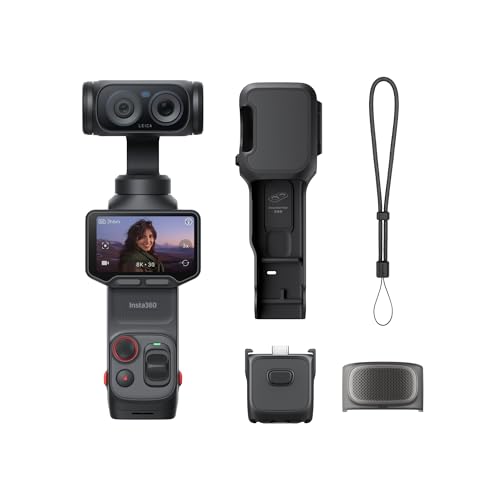
- SUPERIOR VIDEO QUALITY - Capture breathtaking footage with 8K resolution at 30 fps,...
- EXTENDED BATTERY LIFE - Enjoy up to 4 hours of continuous recording with the dual...
- ENHANCED STABILITY - Benefit from advanced Digital Image Stabilization, delivering...
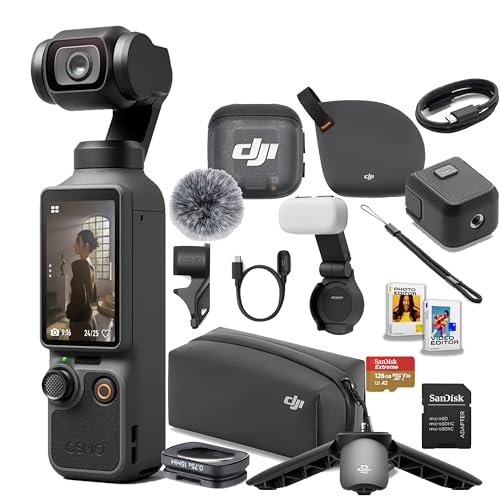
- DJI Osmo Pocket 4-1″ CMOS & 4K/240fps, 14-Stop Dynamic Range, 10-bit D-Log, 3-Axis...
- DJI Mic 3 Clip-On Transmitter/Recorder with Built-In Microphone- For Mic 3 Wireless...
- DJI Wide-Angle Lens for Osmo Pocket 4- Capture a wider image in every frame with this...
One quick note on the stuff people always ask: battery life lands in the same range on both — roughly a couple of hours of real recording — and neither lets you swap the battery, so a dead camera means a USB top-up or a power bank. Neither is waterproof, so plan on a case near water. One Luna bonus: that detachable screen has its own battery, so using it as a remote won’t eat into your recording time.
Where the Luna Ultra wins
For me, the zoom is the standout. That telephoto lens gives you real reach, and a single-lens camera just can’t match it. A lot of what I film when I’m traveling isn’t close by — a stall on the far side of a market, something happening further down the street. With my Pocket 3, I either close the gap and miss the moment, or I crop in and watch the image go soft. A real telephoto this small fixes that, and you see the difference the instant you zoom in.
The pop-off screen is the other big one. Detach it, set the camera down, walk back, and you can still line up the shot with the screen in your hand — no reaching for your phone, no hoping you’re in frame. If you do group shots, or you’re usually the one in front of the lens, that’s a real help, and nothing else this size does it.
Where the DJI Pocket 4 wins
It reads like the lesser camera on a spec list, but in everyday use the Pocket 4 closes that gap fast. This is DJI’s fourth pocket camera — four generations of fine-tuning the gimbal, the tracking, and the color — and you feel it the second it’s in your hand. My Pocket 3 felt dialed in from day one, over a year ago. The Luna is a first-gen product, and first-gen gear almost always ships with little quirks that get ironed out over a year of updates.
Storage is another one. The Pocket 4 keeps 107GB onboard. I lost a whole morning of footage once to a corrupted SD card, and after you’ve been burned like that, storage that can’t go missing stops feeling optional. And if you’re already in DJI’s world, the Pocket 4 drops right in — same mic, same accessories, same color pipeline in the edit. If you’re weighing it against the older model, I broke that down in the Pocket 4 Pro vs Pocket 4 vs Pocket 3 comparison.
Price — and the US availability twist
On price, it’s not close: the Luna Ultra is $769.99, the Pocket 4 starts at $499. Going DJI saves you around $270 and still gets you that proven 1-inch sensor. So the Pocket 4 is the clear value pick — at least, it should be.
Here’s the twist, and for US buyers it might decide everything. DJI landed on the FCC’s Covered List, so the Pocket 4 never cleared for proper US sale — buying one means third-party sellers or imports, usually for more, with no US warranty. The Luna has none of that baggage: Insta360 isn’t on the list, so it’s on Amazon, B&H, and Best Buy with full support. So the pricier camera ends up being the easier and safer one to own here, which flips the usual value argument on its head. It’s gotten even messier since — DJI is now suing to try to ban the Luna in the US. Step outside the US and none of this applies, and the cheaper Pocket 4 gets a lot more tempting.
Which one should you buy?
If you want the more capable camera — that real zoom, and especially the pop-off screen for filming yourself — go Luna Ultra, just give it an update or two before you expect DJI-level polish. If you mostly shoot handheld travel, daily vlogs, and family moments, the Pocket 4 is the cheaper, safer bet, as long as you can get one where you are — and if you already live in DJI’s ecosystem, that pretty much settles it. Me, buying today and shooting mostly handheld travel, I’d probably lean Pocket 4 — though that pop-off screen keeps pulling at me.
Frequently asked questions
It’s the more capable camera — dual lenses, optical zoom, and a detachable remote screen the Pocket 4 can’t match. But the Pocket 4 is cheaper, lighter, more refined, and has more built-in storage. The Luna wins on features; the Pocket 4 wins on value and polish.
Yes. The Pocket 4 uses the same 1-inch sensor and 20mm f/2.0 lens as the Pocket 3, so raw image quality is similar. The upgrades are in tracking, storage, slow motion, and refinement rather than the picture itself.
DJI is on the FCC’s Covered List, so the Pocket 4 isn’t cleared for normal US retail. You can only get it through third-party sellers or imports, usually at a markup and without a US warranty. The Luna Ultra has no such restriction.
About $270. The Insta360 Luna Ultra is $769.99 and the DJI Pocket 4 starts at $499. Outside the US, where both are easy to buy, that gap makes the Pocket 4 the stronger value for handheld shooters who don’t need the zoom.
No. Neither the Luna Ultra nor the Pocket 4 is waterproof, and neither has a swappable battery. Around water or rain you’ll want a case, and for long days, a power bank or a USB top-up.


 English
  Italiano
  Deutsch
  Español
  Português
  Nederlands
  Français